
TEACH Permission to Play
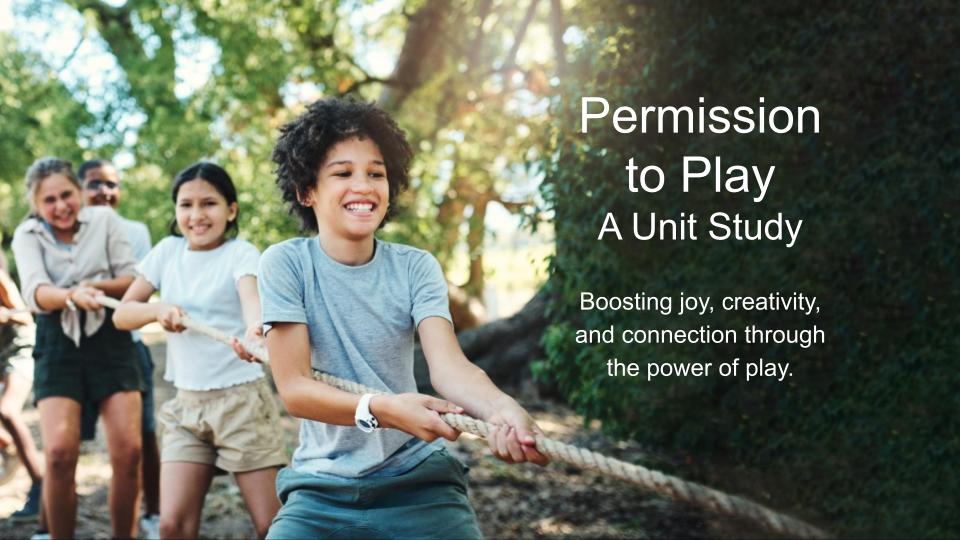
Explore the intersection of positive psychology and autism intervention by teaching your students how to benefit from more play.
Start Teaching!
This comprehensive bundle comes with everything you need to bring Permission to Play into the classroom, from teaching slides and notes to supplementary resources.
Quick Link Library
 10 Minutes

10 Minutes
15 Minutes
5 Minutes
10 Minutes
Behavioral Intervention Plan Recommendations
15 Minutes
15 Minutes
Integration Into Curriculum Instruction
15 Minutes
Expanded Teaching Resources
Lesson Plans & Teaching Materials
- Objectives (PDF)
- Teaching Slides — All Activities (Google Slides)
- Teacher’s Guide (Google Slides, PDF)
- Teacher Answer Key (PDF)
- Unit Study Bundle Pack — All Activities (PDF)
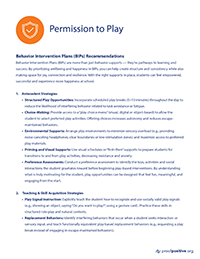
Behavior Intervention Plans (BIPs) are more than just behavior supports — they’re pathways to learning and success. By prioritizing wellbeing and happiness in BIPs, you can help create structure and consistency while also making space for joy, connection and resilience. With the right supports in place, students can feel empowered, successful and experience more happiness at school.
- Antecedent Strategies
- Structured Play Opportunities: Incorporate scheduled play breaks (5–10 minutes) throughout the day to reduce the likelihood of interfering behavior related to task avoidance or fatigue.
- Choice-Making: Provide access to a “play choice menu” (visual, digital or object-based) to allow the student to select preferred play activities. Offering choices increases autonomy and reduces escape-maintained behaviors.
- Environmental Supports: Arrange play environments to minimize sensory overload (e.g., providing noise-canceling headphones, clear boundaries or low-stimulation zones) and maximize access to preferred play materials.
- Priming and Visual Supports: Use visual schedules or “first–then” supports to prepare students for transitions to and from play activities, decreasing resistance and anxiety.
- Preference Assessments: conduct a preference assessment to identify the toys, activities and social interactions the student gravitates toward before beginning play-based interventions. By understanding what is truly motivating for the student, play opportunities can be designed that feel fun, meaningful, and engaging from the start.
- Teaching & Skill Acquisition Strategies
- Play Signal Instruction: Explicitly teach the student how to recognize and use socially valid play signals (e.g., showing an object, saying “Do you want to play?, using a gesture card). Practice these skills in structured role-play and natural contexts.
- Replacement Behaviors: Identify interfering behaviors that occur when a student seeks interaction or sensory input, and teach functionally equivalent play-based replacement behaviors (e.g., requesting a play break instead of engaging in escape-maintained behaviors).
- Special Interest Integration: Embed the student’s special interests into academic and social play activities to increase motivation, sustain engagement and generalize skills.
- Reinforcement Strategies
- Play-Based Reinforcers: Use access to play based reinforcers (games, movement, special interest time) as positive reinforcement for meeting behavioral expectations. Ensure reinforcement is immediate and contingent on the target behavior.
- Social Reinforcement Through Play: Pair adult and peer attention with play activities to strengthen the social value of engagement (e.g., playing a board game together as reinforcement).
- Token Economy with Play Rewards: Incorporate play-based items or activities into reinforcement menus (e.g., extra time with building blocks, a game of Uno or a short dance break).
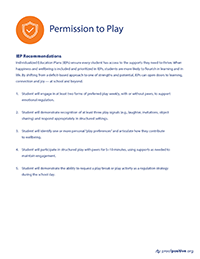
Individualized Education Plans (IEPs) ensure every student has access to the supports they need to thrive. When happiness and wellbeing is included and prioritized in IEPs, students are more likely to flourish in learning and in life. By shifting from a deficit-based approach to one of strengths and potential, IEPs can open doors to learning, connection and joy — at school and beyond.
- Student will engage in at least two forms of preferred play weekly, with or without peers, to support emotional regulation.
- Student will demonstrate recognition of at least three play signals (e.g., laughter, invitations, object sharing) and respond appropriately in structured settings.
- Student will identify one or more personal “play preferences” and articulate how they contribute
to wellbeing. - Student will participate in structured play with peers for 5–10 minutes, using supports as needed to maintain engagement.
- Student will demonstrate the ability to request a play break or play activity as a regulation strategy
during the school day.
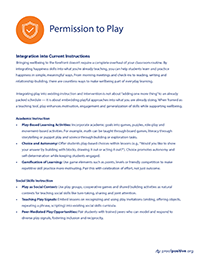
Bringing wellbeing to the forefront doesn’t require a complete overhaul of your classroom routine. By integrating happiness skills into what you’re already teaching, you can help students learn and practice happiness in simple, meaningful ways. From morning meetings and check-ins to reading, writing and relationship-building, there are countless ways to make wellbeing part of everyday learning.
Integrating play into existing instruction and intervention is not about “adding one more thing” to an already packed schedule — it is about embedding playful approaches into what you are already doing. When framed as a teaching tool, play enhances motivation, engagement and generalization of skills while supporting wellbeing.
Academic Instruction
- Play-Based Learning Activities: Incorporate academic goals into games, puzzles, role-play and
movement-based activities. For example, math can be taught through board games, literacy through storytelling or puppet play and science through building or exploration tasks. - Choice and Autonomy: Offer students play-based choices within lessons (e.g., “Would you like to show your answer by building with blocks, drawing it out or acting it out?”). Choice promotes autonomy and self-determination while keeping students engaged.
- Gamification of Learning: Use game elements such as points, levels or friendly competition to make repetitive skill practice more motivating. Pair this with celebration of effort, not just outcome.
Social Skills Instruction
- Play as Social Context: Use play groups, cooperative games and shared building activities as natural contexts for teaching social skills like turn-taking, sharing and joint attention.
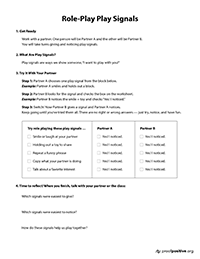
- Teaching Play Signals: Embed lessons on recognizing and using play invitations (smiling, offering objects, repeating a phrase, scripting) into existing social skills curricula.
- Peer-Mediated Play Opportunities: Pair students with trained peers who can model and respond to diverse play signals, fostering inclusion and reciprocity.
Communication and Language Interventions
- Play as a Communication Platform: Use preferred play activities as contexts for practicing functional communication, including requesting, commenting and rejecting.
- AAC and Play: Embed augmentative and alternative communication (AAC) systems into play contexts so students can request favorite games, describe actions or share enjoyment.
- Narrative and Pretend Play: For students ready for more complex language, use pretend or story-based play to practice sequencing, perspective-taking and expressive language skills.
Behavior and Self-Regulation Supports
- Play Breaks as Regulation Tools: Teach students to request a play break as an alternative to escape-maintained behaviors. Play breaks can include movement games, sensory play or access to special interests.
- Embedding Interests: Integrate student special interests into instructional tasks to increase engagement and reduce challenging behaviors. For example, a student who loves trains might practice reading comprehension with train-themed stories or counting with toy trains.
- Transition Supports: Use playful rituals (songs, chants, quick games) to ease transitions and reduce stress during schedule changes.
Classroom Culture and Routines
- Playful Morning Meetings: Begin the day with a short playful activity, such as a joke round, movement stretch or “two truths and a tall tale” game.
- Play Corners or Choice Centers: Maintain accessible areas in the classroom where students can engage in structured or unstructured play during breaks or reinforcement times.
- Celebrating Play Diversity: Highlight and normalize different types of play in the classroom (e.g., sensory play, collecting, scripting, storytelling), ensuring autistic play styles are valued alongside neurotypical forms.
Classroom Activities
Each activity includes teacher notes and differentiated instruction across skill levels
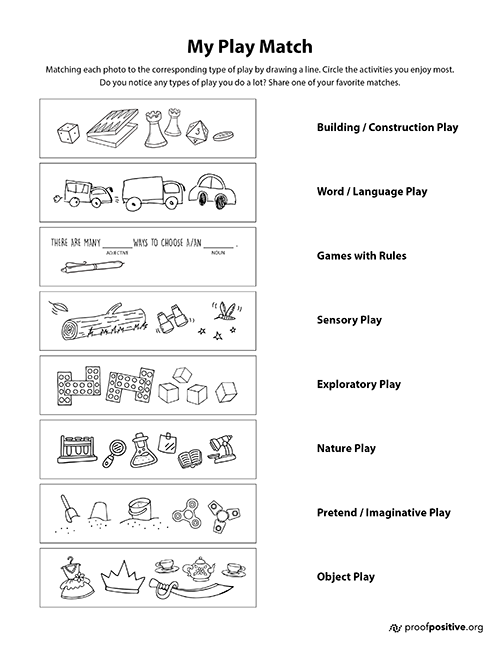
- Activity 1: Discovering Play Types
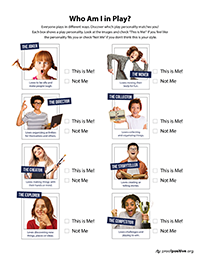
25 Minutes / Google Slides + Teacher Notes / Student Worksheets (PDF) - Activity 2: My Play Personality
30 Minutes / Google Slides + Teacher Notes / Student Worksheets (PDF) - Activity 3: Play Signals & Invitations
25 Minutes / Google Slides + Teacher Notes / Student Worksheets (PDF) - Activity 4: Permission to Play Breaks
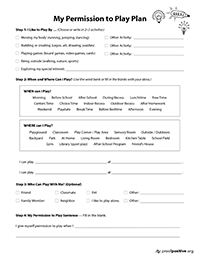
30 Minutes / Google Slides + Teacher Notes - Activity 5: Designing a Play Plan
45-60 Minutes / Google Slides + Teacher Notes / Student Worksheets (PDF) - Unit Study Bundle Pack — All Activities (PDF)