
What if a child doesn’t believe she is creative? What if she doesn’t see herself as curious, confident, or someone who perseveres? We can tell her she has those strengths. We can define them, post them on classroom walls, and point them out in books. Or we can do what Vashti’s teacher does in Peter H. Reynolds’ The Dot. We can give her somewhere small to begin.
In the story, Vashti sits in front of a blank piece of paper, convinced she can’t draw. Her teacher doesn’t argue or lecture her about perseverance. She simply invites her to make a mark. So Vashti does. It’s just a dot. Then her teacher does something important: she notices it. She frames the dot and hangs it above her desk. Vashti begins to wonder what else she might do, and soon she’s experimenting with colors and sizes, eventually discovering how to make a dot without even painting it.
We often talk about character strengths as qualities children must bring to a challenge. Persevere. Be brave. Be curious. The Dot shows it can work the other way around. The experience comes first, and the strength emerges because a child was given the chance to use it. Vashti doesn’t become confident and then create. She creates something small. Someone notices. She tries again. Creativity grows. Perseverance follows. Curiosity takes hold.
Education is tempted to turn character strengths into another curriculum:
- Define perseverance.
- Identify an example of creativity.
- Circle the character who demonstrates curiosity.
Activities like these build the language to recognize strengths, and that matters. But awareness is only the beginning. To draw on their strengths when something is difficult, unfamiliar, or uncertain, children need chances to experience themselves using them. That’s where the science of happiness becomes something children actually live.
It also shifts the question for us as educators. Instead of only asking, “How do I teach perseverance?” we can ask, “What can I create today that gives a child the chance to experience herself persevering?” And then: Am I paying close enough attention to notice?
When we do, we can say:
- “You kept going even when that was hard.”
- “You tried another way.”
- “You asked a question no one else thought to ask.”
- “You noticed someone needed help.”
This is strength spotting. It connects words like perseverance, creativity, curiosity, and kindness to something real a child has done.
The Dot ends with one final reminder of how powerful this can be. Vashti meets a boy who says he can’t draw. Now she is the strength spotter. She doesn’t simply tell him he can draw. She gives him an opportunity, just as her teacher once did for her. And after he makes his mark, Vashti asks him to sign it. The circle is complete.
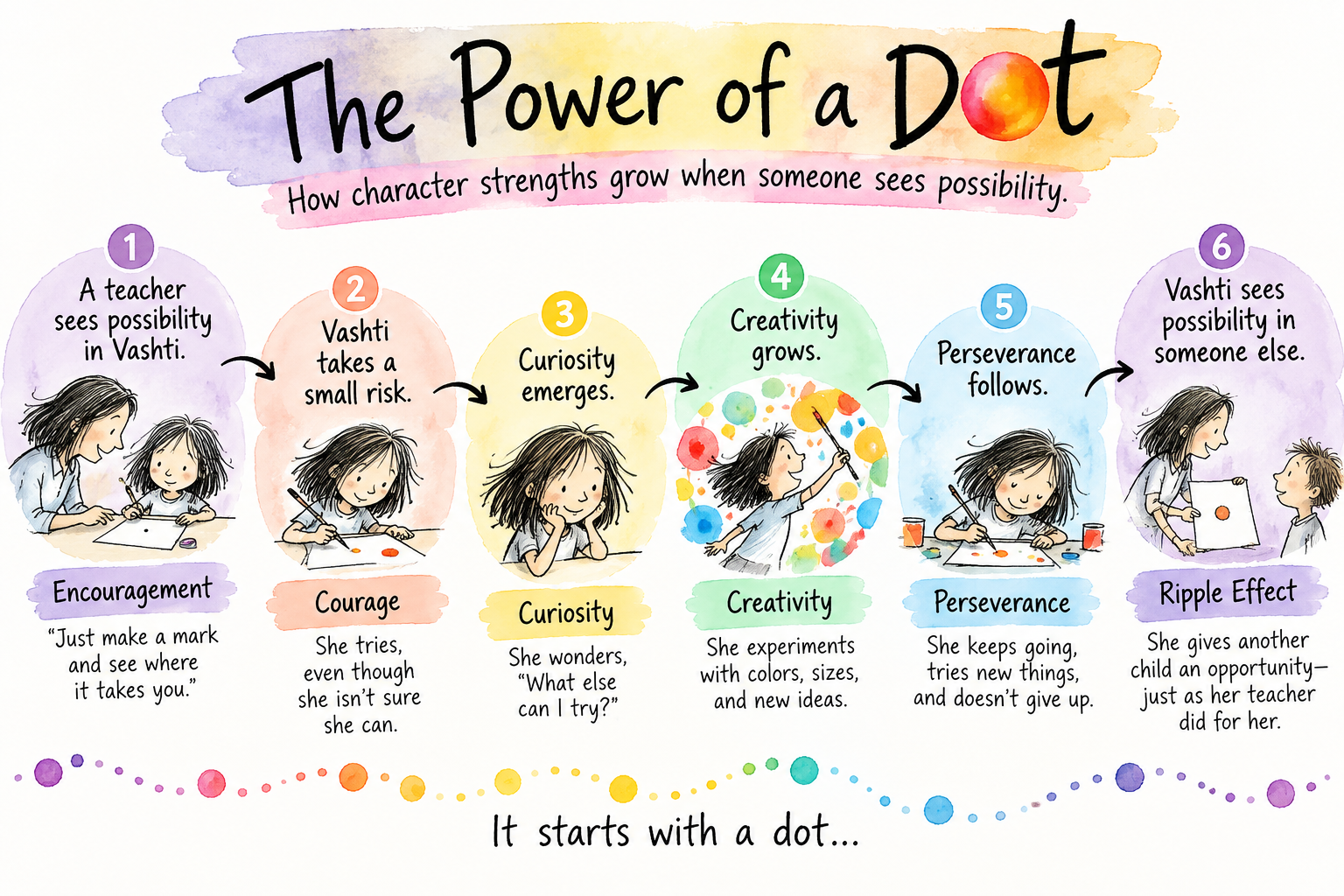
That’s the science of happiness coming alive in a classroom. Perhaps our job isn’t always to tell children which strengths to use. Sometimes it’s to create the conditions for them to discover those strengths, notice what happens, and name what they just did. Because discovering something powerful about yourself can begin with something very small. Sometimes, it starts with a dot.
